Introduction
The Power & Light Building is one of Kansas City’s most recognizable landmarks since its completion in 1931. Designed by architectural firm Hoit, Price & Barnes, the Art Deco skyscraper stood as an optimistic symbol for the city during the early years of the Great Depression. For decades it remained the tallest building in Missouri, its illuminated spire visible across the city skyline.
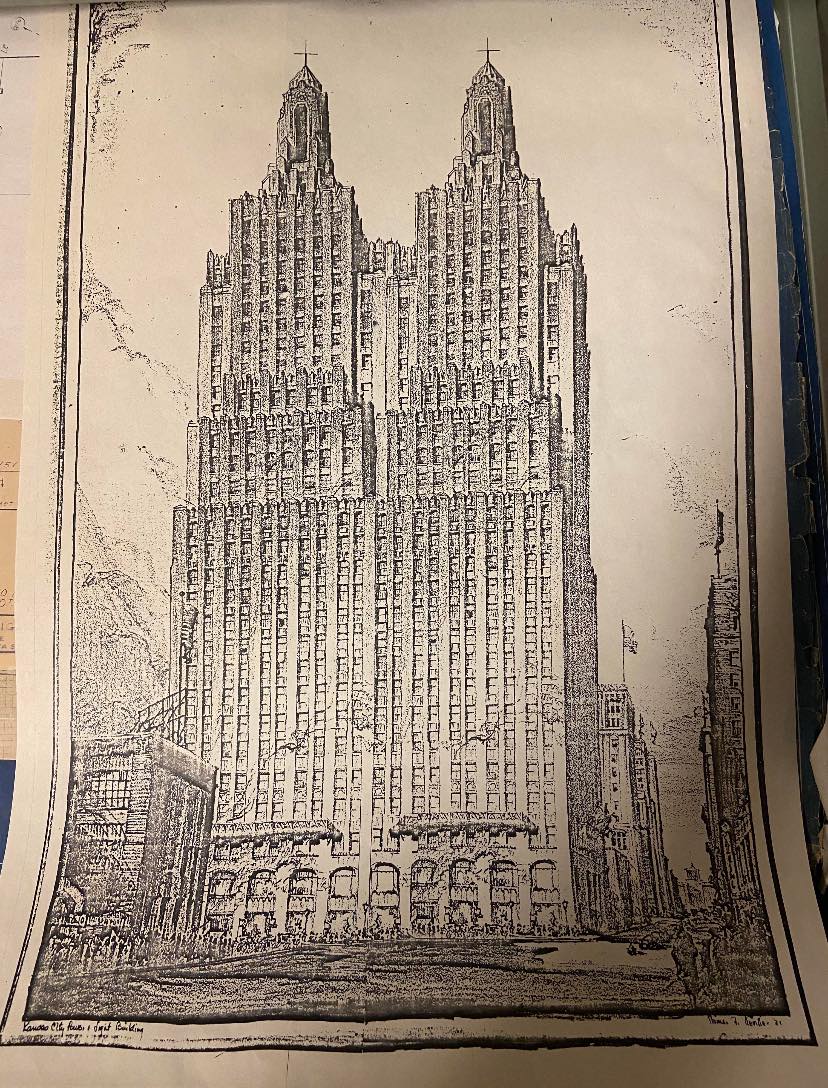
Despite it being an extensively documented building over the years, one peculiar detail about the building has long fueled speculation. The western side of the structure is largely windowless, with a plain and blank wall on an otherwise ornate building. The lot next door on this western side lay bare and nothing was ever except a parking lot.
These strange details have led to rumors and speculation that the Power & Light Building was originally supposed to have a twin tower, but due to the effects of the Great Depression, the second tower never came to be.
Recently, a photo surface online that seemed to support the theory which intrigued me. Curious about the origins of this rumor, I started digging into the history of claims and the image itself.
What followed turned into a surprisingly deep rabbit hole.
The Chase Begins
Stories about a second tower attached to the Power & Light Building have circulated for at least the past decade. On the surface, the idea seems plausible; which is why it spread like wildfire. The western side lacked windows and the empty lot next door definitely raises some eyebrows.
The earliest mention that I could find online was an article published on December 5th, 2013 by the Kansas City Business Journal titled “My Favorite Building: Power & Light Building”. The article, written by Austin Alonzo, interviews local architects about their favorite buildings in KC.
The article states that according to a Research PDF from the Missouri DNR (later determined to be the application for the building to be added to the National Register of Historic Places), that the original plans called for a second building but the money was not there during the Great Depression.
Reading this document myself, it did not reveal any mention of a second tower or mention of design choices that intended such a plan.
After Mr. Alonzo’s original article was published, local historian Duane Hicks contacted the author via email to dispute the twin-tower theory. The original article was then followed up by Mr. Alonzo again on December 19, 2013. According to this new article, Alonzo claimed that:
“Research I found from the Missouri Department of Natural Resources, as well as other locations, suggested that side of the building – which was finished in 1931 – was intentionally left blank as part of a larger plan to build a twin tower next to the skyscraper.” – Austin Alonzo
Again, Austin Alonzo never cited what resources led him to make that inference.
Duane Hicks was a Kansas State University graduate and had researched the building as part of a project in the 80s. He had direct access to the original plans, documentation, and various other articles of information.
Hicks even interviewed Clarence Kivett, who had worked with the architectural firm during the building’s construction. Kivett was adamant there were never plans for a second tower.
The far more practical explanation was that the western wall was designed as a firewall, intended to protect the structure if another building was to ever be constructed on the neighboring lot. That side of the building also houses the elevator shafts, which further explains the lack of windows.
For many years, that explanation seemed to settle the debate…. until a new image brought the rumor back into the limelight.
The Reddit Photo
On August 25, 2020, a Reddit user under the name “kcgtiguy” posted an intriguing image to the Kansas City subreddit.
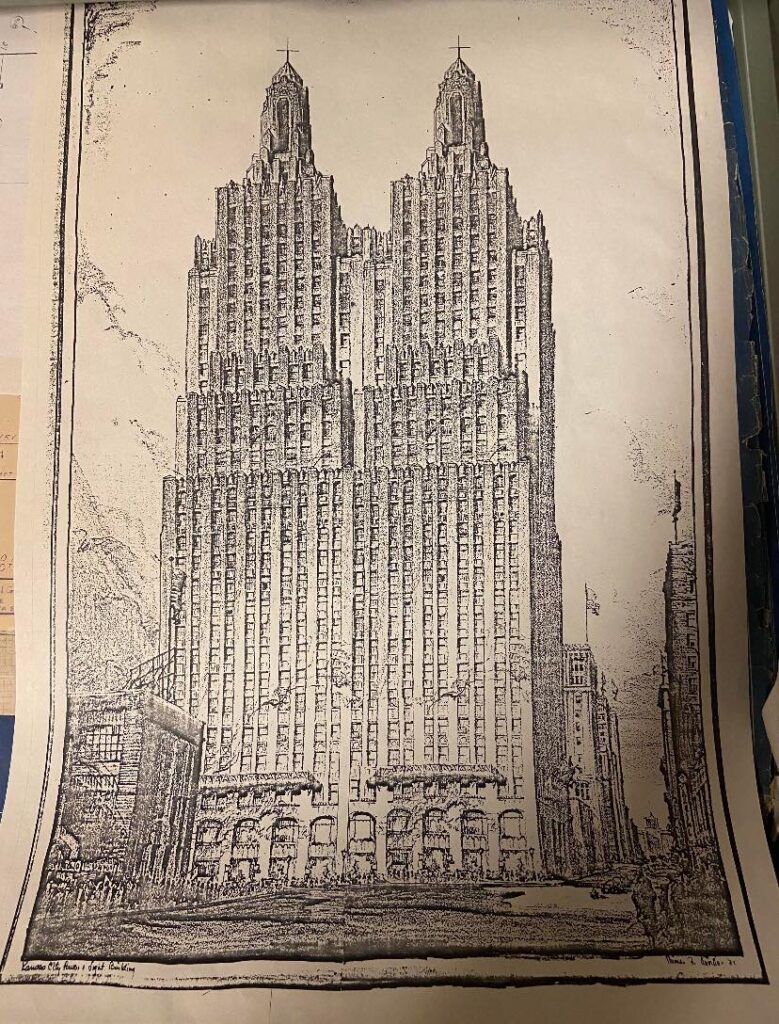
The post claimed this was an original 1931 drawing of the Power & Light Building showing what was actually meant to be.
According to the poster:
“I work at the Power and Light Building and found this amongst old blueprints yesterday. The blank west side has always been a contested thing, but finding this from 1931 may be the best answer to the twin tower rumor. It appears that there was in fact a plan for a twin and I believe this is the only known drawing of said tower. I was so shocked and excited when this slipped out!” – kcgtiguy
At first glance, this photo looked convincing. The drawing appeared to be resting among mechanical plans and building documents which added some credence to the claim. It was dated 1931, and it bore a signature. Unfortunately, the photo was too blurry to read it clearly.
Several details about this find raised significant questions.
The poster provided only vague credentials (“I work at the Power and Light Building”), and the discovery supposedly happened just the day before. Considering that the building is one of the most thoroughly documented structures in Kansas City, it seemed unlikely that such a significant drawing would’ve remained unnoticed; especially when Duane Hicks already reviewed the archives decades earlier.
The image itself also contained technical inconsistencies:
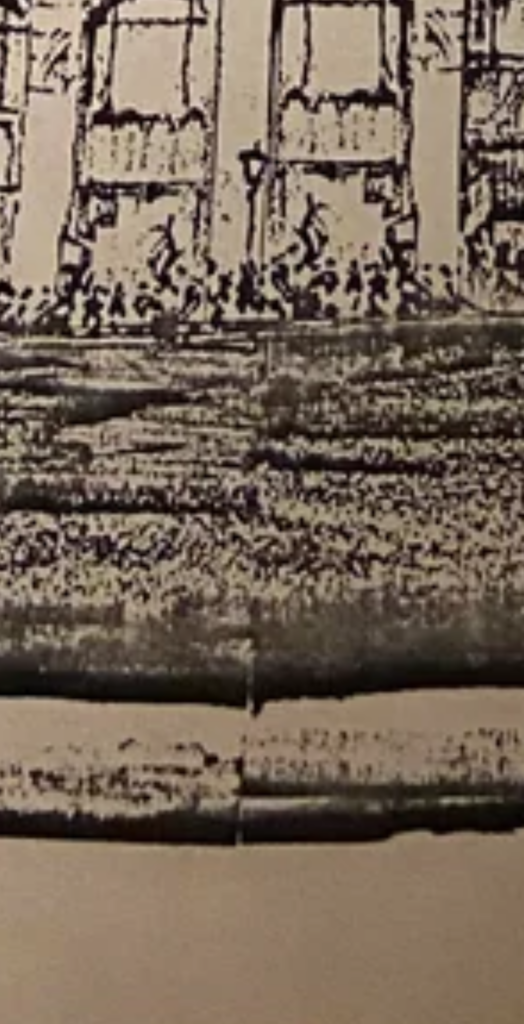
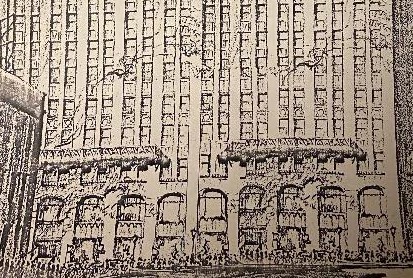
The drawing appeared to be a photocopy, yet photocopiers did not exist until around 1950; not becoming widely used until the 1960s. Even more telling were the visible artifacts in the image. There are obvious repeating splits and distortions that appear in both towers. If this were simply a photocopy of an original drawing, those duplicated artifacts should not exist.
The original poster also claimed to have additional documents to share, but no further material ever appeared and requests for a better scan went unanswered.
The Facebook Debate
The following day, the same image was shared in a Kansas City local history group on Facebook, sparking a lengthy debate about its authenticity.
Once users began pointing out the various image artifacts and the historical issues surrounding the photocopy, the drawing was widely dismissed as a hoax or an altered image. Many commenters referenced the same 2013 Business Journal article and the research conducted by Hicks.
Still, one question remained: If the image was a fake, where did it come from?
Finding the Original Image
Tracking down the source proved difficult. Many photographs of the Power & Light Building exist from the same vantage point, but none matched the Reddit image exactly.
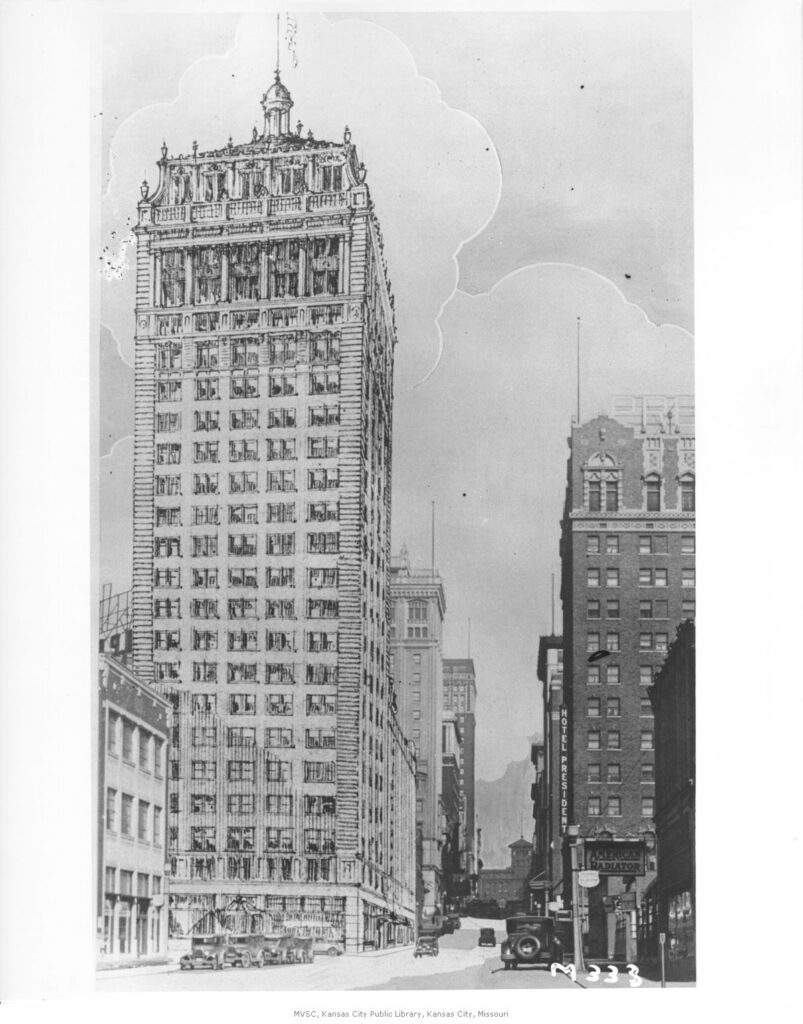
One close match came from the Missouri Valley Special Collections which showed a photograph of the same skyline view combined with a hand-drawn architectural concept; likely created prior to the design of the building we have today.
Eventually, I made a discovery that proved to be an important piece to the puzzle.
In 2022, someone posted an image to the same Facebook group showing what appeared to be the unaltered version of the drawing. Unlike the Reddit image, this one was framed and hanging on a wall in a private home. The poster stated that her sister owned it and that it was an original charcoal drawing.
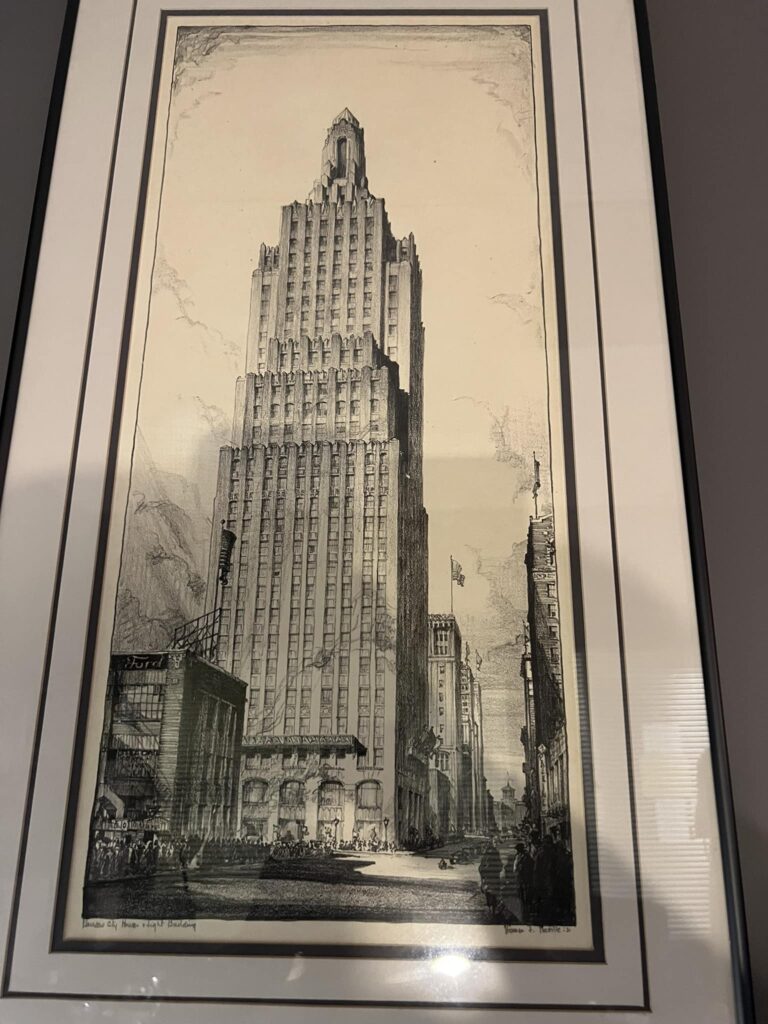
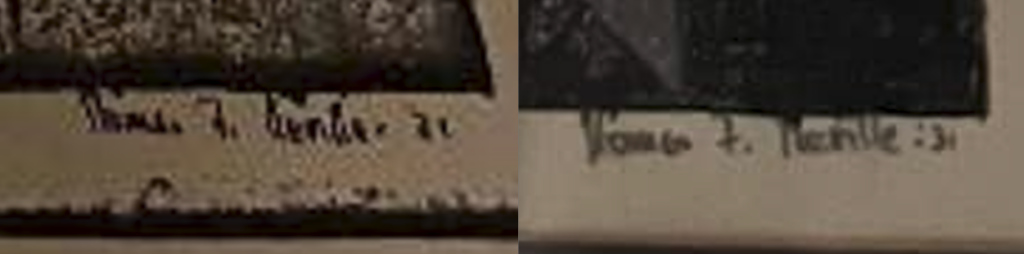
The two images were clearly related. They shared the same composition, similar labels, and the same date of 1931. The only notable difference I could see was the signatures between the two images differing slightly in their strokes. This version also contained the same artifacts previously identified in the altered photo.
This strongly suggests that the Reddit image was created by digitally altering a reproduction of the original artwork.
Identifying the Artist
I wanted to find out who drew the original image. I theorized that this may help me find a digital copy of the drawing if one did exist online. While researching buildings from the same era, I stumbled upon another clue.
The Municipal Auditorium, another iconic Kansas City Art Deco structure, was designed by architectural firm Gentry, Voskamp & Neville. That firm collaborated closely with Hoit, Price & Barnes, the designers who would eventually build the Power & Light Building.
One of the partners in that firm was Homer F. Neville.
Although Neville is not a documented designer of the Power & Light Building itself, the signature on the drawings do appear to be his name. Given the close professional relationship between the two firms, it is entirely plausible that Neville produced an artistic rendering of the soon-to-be tower. Unfortunately we will never know for sure as Neville passed away in 1991 at the age of 91.
A Possible Explanation
While many questions remain unanswered, the evidence suggests a plausible chain of events.
The original drawing (or drawings) were likely created around 1931 by Homer F. Neville, as an artistic depiction of the Power & Light Building. Over the decades, multiple photocopies or even reproductions may have been circulated.
At some point, likely sometime in the mid 2000s or early 2010s, a digital scan of the drawing was made and then altered. A second tower would be added to the composition, which was then reprinted, and placed with other building documents in the Power & Light Building. This could’ve been done for a multitude of reasons; as a joke, a concept rendering, or an attempt to start a hoax.
This altered image was likely mistaken for a legitimate historical document and would spread by word of mouth, through various documents, and papers published online. This is likely where Austin Alonzo received the information that there were plans for a second tower. This also explains why Duane Hicks never discovered this image when digging through the original plans and paperwork.
This altered image would eventually be rediscovered in 2020 by the Reddit user who again, like many before them, mistook the image as a historical document and shared it online.
In reality, it may have been the altered image itself that helped create and perpetuate this myth.
There is also still a chance that this was merely kcgtiguy creating an elaborate hoax, but I couldn’t find any information that lead credence to that. The user is still active to this day on that Reddit account, which is highly unusual for accounts that perpetuate hoaxes on the website.
The Mystery Continues
There are still many unanswered questions:
Who altered the drawing?
When was the image altered?
Was it meant as a prank, a concept sketch, or something else entirely?
And perhaps the most interesting of all: how did this altered image allegedly end up among the documents inside the Power & Light Building?
For now, the evidence suggests the twin-tower drawing is not proof of a lost architectural plan, but rather the result of a clever Photoshop job layered onto a genuine scan of 1930s artwork.
Without the rest of these questions answered, I’m hard-pressed to claim this mystery 100% solved. I think that my theory is pretty solid and is based very heavily in available research and testimony by trusted individuals, but it remains just that: a theory.
Like many other good urban legends, the story of the Power & Light Buildings twin will probably continue circulating for years to come.
What do you think?
No responses yet